
Fertilizer production is one of the most chemically aggressive industrial environments in operation today. From raw material handling through finished product storage, plant infrastructure is continuously exposed to corrosive chemicals, elevated temperatures, moisture, and mechanical wear. Over time, these conditions can compromise concrete, steel, and protective linings, leading to safety risks, unplanned outages, and costly repairs.
Understanding where corrosion occurs and how to properly protect those areas is critical to maintaining reliable operations, without unplanned outages. Below, we explore common corrosive zones within fertilizer plants, the chemicals responsible, and proven Sauereisen solutions engineered to perform in these demanding environments.
Where Corrosion Commonly Occurs
Secondary Containment Areas
Secondary containment systems are designed to capture leaks, spills, and washdown water, but in fertilizer plants they can often be exposed to aggressive chemicals on a daily basis due to leakage or spills. Standing corrosive liquids, fluctuating pH levels, and temperature cycling can quickly degrade unprotected concrete.
Typical challenges include:
- Acid and alkali attack on concrete
- Cracking from thermal cycling resulting from cleaning or chemical reactions
- Chemical migration through porous substrates resulting in soil contamination
Process Floors and Equipment Pads
Process floors support heavy equipment while enduring constant chemical exposure, abrasion, and impact. Fertilizer dust, acidic condensate, and frequent washdowns accelerate deterioration, particularly at joints and cracks.
High-risk areas include:
- Granulation and prilling areas
- Reactor and mixer floors
- Chemical storage and distribution areas
- Load-out and packaging zones
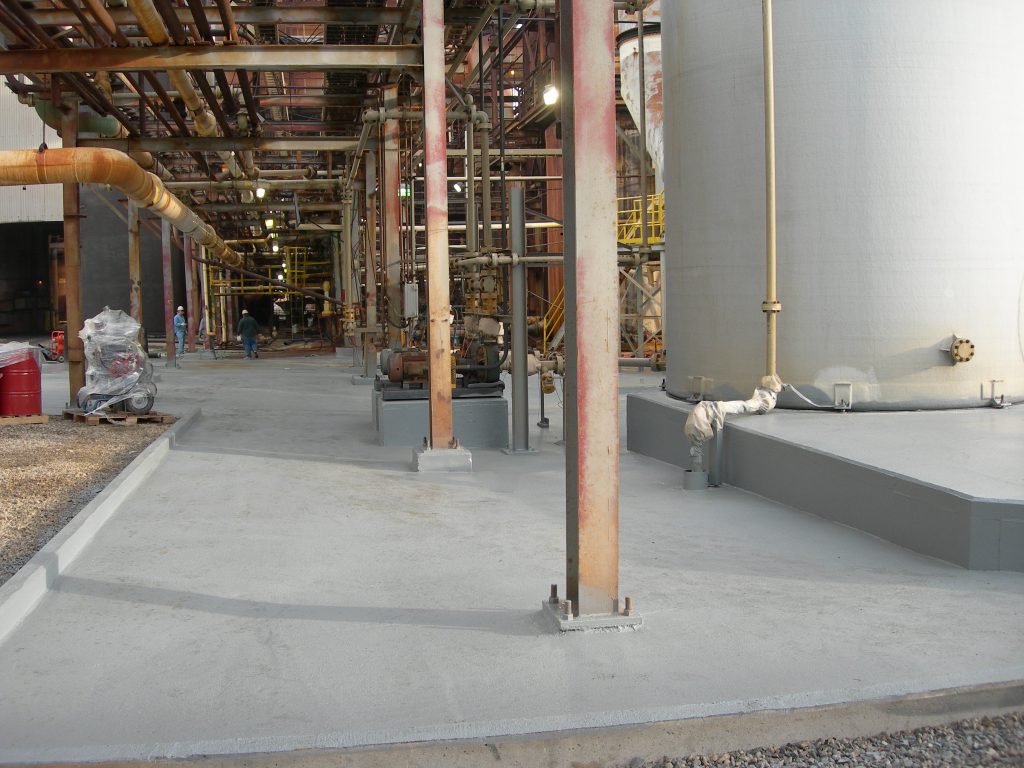
Containment Trenches and Sumps
Trenches and sumps collect chemical runoff and process liquids, making them some of the most severely exposed areas in the plant. Poor drainage and prolonged immersion can further intensify corrosion.
Sulfur Pits and Sulfur Handling Areas
Sulfur pits and related infrastructure face a unique combination of challenges: elevated temperatures, molten sulfur, sulfur dioxide off–gassing, and sulfuric acid formation due to moisture and oxidation. These environments are especially destructive to conventional concrete and carbon steel.
Pump Bases and Equipment Foundations
Pump bases are subjected to chemical splashes, pump leakage, vibration, and frequent maintenance activity. Once corrosion penetrates beneath baseplates, structural integrity and alignment can be compromised, affecting pump performance and efficiency.
Common Corrosive Chemicals in Fertilizer Plants
Fertilizer production involves a wide range of aggressive chemicals, many of which attack concrete and steel rapidly:
- Sulfur Dioxide (SO₂): Forms sulfurous and sulfuric acids in the presence of moisture
- Sulfuric Acid: Highly corrosive to concrete and metals
- Phosphoric Acid: Aggressively attacks calcium-based materials
- Ammonium Nitrate and Ammonia Compounds: Contribute to chemical degradation and stress cracking
- Chlorides and Fluorides: Accelerate corrosion of steel and reinforcing
- Alkalies used in neutralization
These chemicals often act in combination or in reaction, increasing thermal shock potential and the severity of corrosion, and reducing the lifespan of unprotected substrates.
Sauereisen Solutions for Fertilizer Plant Protection
For more than a century, Sauereisen has engineered materials specifically designed to withstand extreme chemical, thermal, and mechanical conditions. Our solutions are tailored to the unique demands of fertilizer production facilities.

Polymer Concretes
Sauereisen polymer concretes provide exceptional resistance to acids, solvents, and salts while offering high compressive strength, low permeability, and high temperature service up to 1,400o F.
Ideal applications include:
- Sulfur pits
- Secondary containment floors and curbs
- Pump bases and equipment pads
- Trench and sump rehabilitation
Unlike traditional cementitious materials, polymer concretes cure quickly and forms a dense, chemically resistant barrier that protects underlying substrates.
Protective Membranes and Linings
Chemical–resistant membranes, in conjunction with polymer concretes, refractories or linings, create seamless protection for large surface areas exposed to continuous chemical attacks.
Key benefits:
- Excellent resistance to sulfuric and phosphoric acids
- Crack-bridging capability
- Reduced downtime during installation
These systems are commonly used in secondary containment, process floors, and containment trenches to enhance overall protection where long-term chemical exposure is unavoidable.
Acid-Resistant Refractories and Brick Systems
High-temperature zones such as sulfur pits and reactors demand materials that can withstand both heat and corrosion.
Sauereisen refractories and acid-resistant masonry systems are engineered to:
- Resist sulfur dioxide and acid attack
- Maintain integrity at elevated temperatures of 1,000o F or greater
- Provide long service life in harsh operating conditions
A Proactive Approach to Asset Protection
In fertilizer plants, corrosion is not a matter of if, but when. Proactively protecting critical infrastructure with the right materials can dramatically extend service life, improve safety, reduce maintenance costs, and prevent unplanned outages.
By providing polymer concretes, chemical-resistant membranes, and specialty refractories and linings, Sauereisen delivers complete, application-specific solutions for the most corrosive areas of fertilizer production facilities in both new construction and rehabilitation of existing plants.
The result: durable protection that stands up to aggressive chemicals, harsh operating conditions, including corrosive attack, high temperatures, and the realities of round-the-clock production.