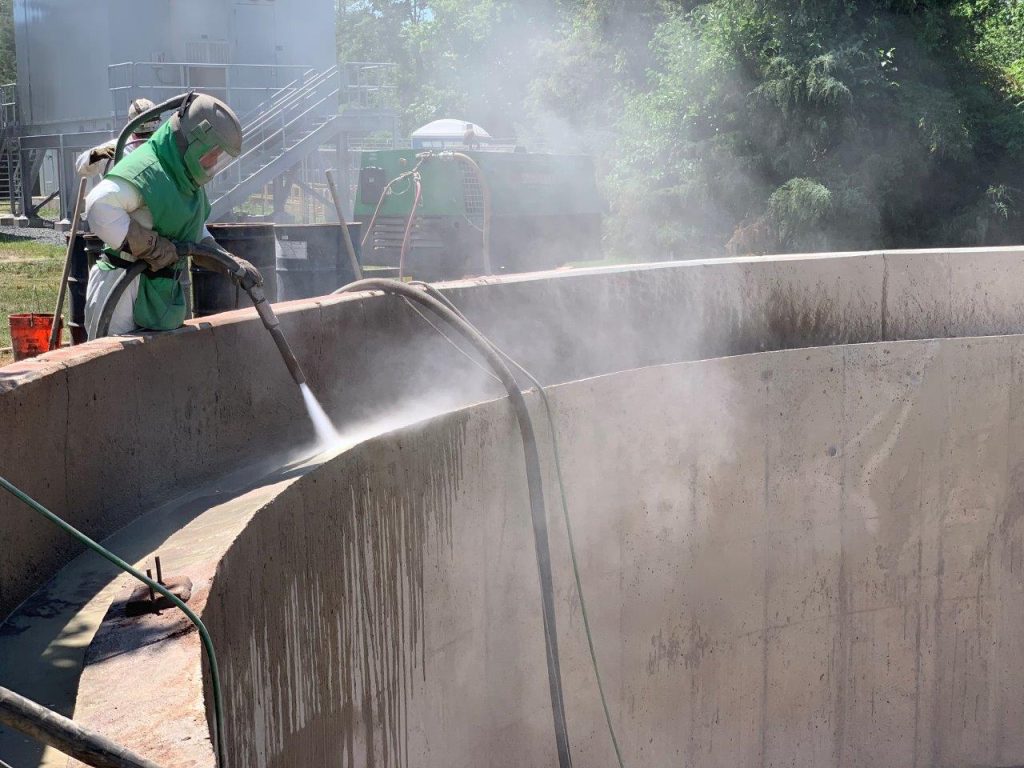
Protective coatings and linings on concrete are only successful when the concrete substrate beneath them is structurally sound and properly prepared. In wastewater facilities, chemical processing plants, power stations, and industrial environments, coating and lining failures are often traced back not to the coating itself, but to improper surface preparation or unsuitable concrete conditions prior to application.
Whether the project involves new construction or rehabilitation, proper surface preparation and resurfacing of concrete substrates are essential to achieving long-term coating performance, adhesion, and corrosion resistance.
The Hidden Problem with New Concrete
New concrete is frequently assumed to be ready for coating shortly after placement. In reality, there are often conditions in new concrete that can compromise coating adhesion and long-term performance.
Common issues include:
- Surface laitance
- Excess moisture
- Concrete admixtures
- Curing compounds and form release agents
- Bug holes and voids
- Honeycombing
- Uneven surfaces
- Weak or contaminated surface layers
Even new, virgin concrete requires careful preparation and resurfacing before a protective lining system can be successfully installed.
Why Surface Preparation Matters
Protective coatings and linings depend on mechanical adhesion to the substrate. If contaminants, weak surface layers, or smooth finishes remain in place, coatings may not bond properly, subsequently blistering, delaminating, or failing prematurely.
Proper surface preparation of both new and existing concrete substrates will:
- Eliminate laitance, curing compounds and form release agents on new concrete
- Remove weak or contaminated concrete in existing substrates
- Create the required surface profile for adhesion
- Open concrete pores for primer penetration
- Improve long-term bond strength
- Extend coating service life
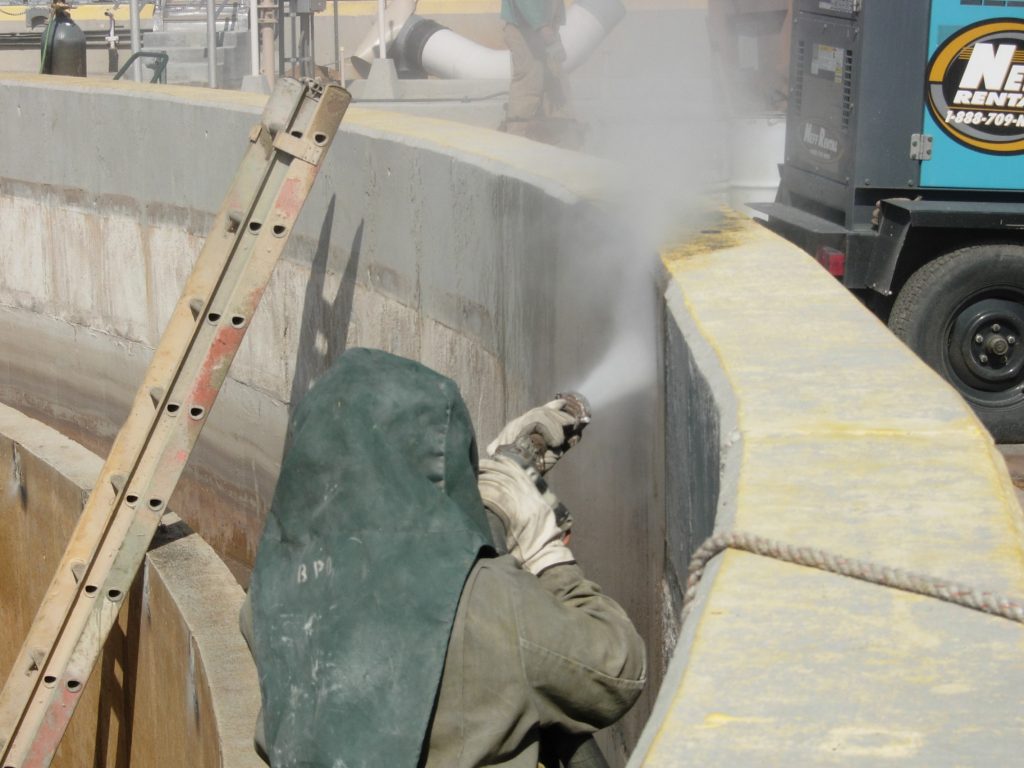
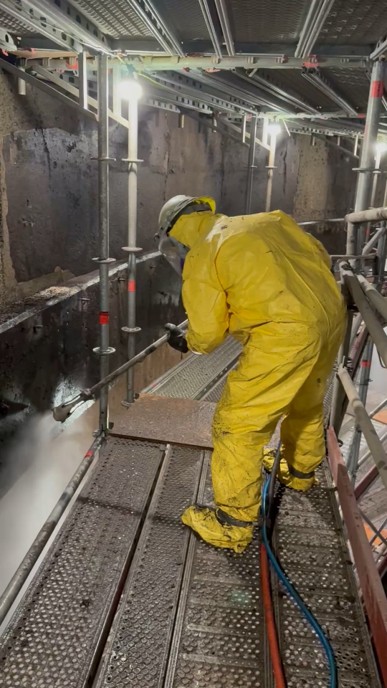
Preparation methods often include abrasive blasting, mechanical grinding, scarification or ultra-high-pressure water jetting depending on substrate condition and project requirements.
Coating and lining manufacturers’ surface preparation requirements should always be carefully followed.
The Role of Concrete Resurfacing
In most industrial environments, surface preparation alone is not enough. Concrete substrates damaged by corrosion, abrasion, chemical attack, or poor placement practices will require resurfacing before coatings can be applied.
Resurfacing materials restore the substrate to a sound, uniform condition while providing a suitable surface for lining installation.
Benefits of resurfacing include:
- Repairing damaged or exposed aggregate areas
- Replacing severely deteriorated areas of the substrate
- Providing a uniform surface plane for the application of the protective system
- Restoring structural integrity and maintaining proper slope
- Filling voids and bug holes in new concrete
- Enhancing long-term system durability by minimizing irregularities in the protective system
Resurfacing is particularly important in wastewater treatment plants and chemical containment areas where acidic or caustic chemicals and the sulfuric acid generated by microbiologically induced corrosion (MIC) or abrasion have degraded the concrete substrate, leaving it unsuitable for the direct application of a protective coating or lining system.
Moisture and pH Considerations
Two of the most overlooked factors in coating performance are moisture content and surface pH.
Excess moisture in the concrete or moisture vapor transmission can cause blistering, osmotic failure, or loss of adhesion beneath impermeable coatings. Similarly, low surface pH caused by carbonation or chemical attack can interfere with proper bonding and curing. The pH level of both new and existing concrete must be well above neutral, with the industry standard typically calling for a minimum pH of 9.
Testing and verification in accordance with SSPC/NACE (AMPP) standards prior to coating application is essential to confirm that the substrate is suitable for a coating or lining system that will provide long-term service.
Achieving Long-Term Performance
Asset owners and engineers increasingly recognize that protective coating and lining systems should be viewed as complete systems, and as such, these installations require attention to:
- Proper concrete cure
- Thorough surface preparation
- Concrete repair and resurfacing
- Substrate testing procedures
- Primer selection when required
- Environmental controls during installation and curing
Skipping preparation steps to save time often results in far greater costs later due to premature failures, production interruptions, emergency repairs, or costly removal and replacement of failed systems.
Conclusion
Concrete surface preparation and resurfacing are foundational steps in any successful coating or lining project. A high-performance system applied over an improperly prepared or weak substrate will never achieve its intended service life.
By investing in and requiring proper surface preparation, substrate evaluation, and resurfacing, asset owners can significantly improve coating and lining adhesion, corrosion resistance, and long-term durability, while extending service life and minimizing maintenance and downtime.
In aggressive industrial and wastewater environments, the condition and proper preparation of the concrete beneath the coating ultimately determines the success of the entire protective system.