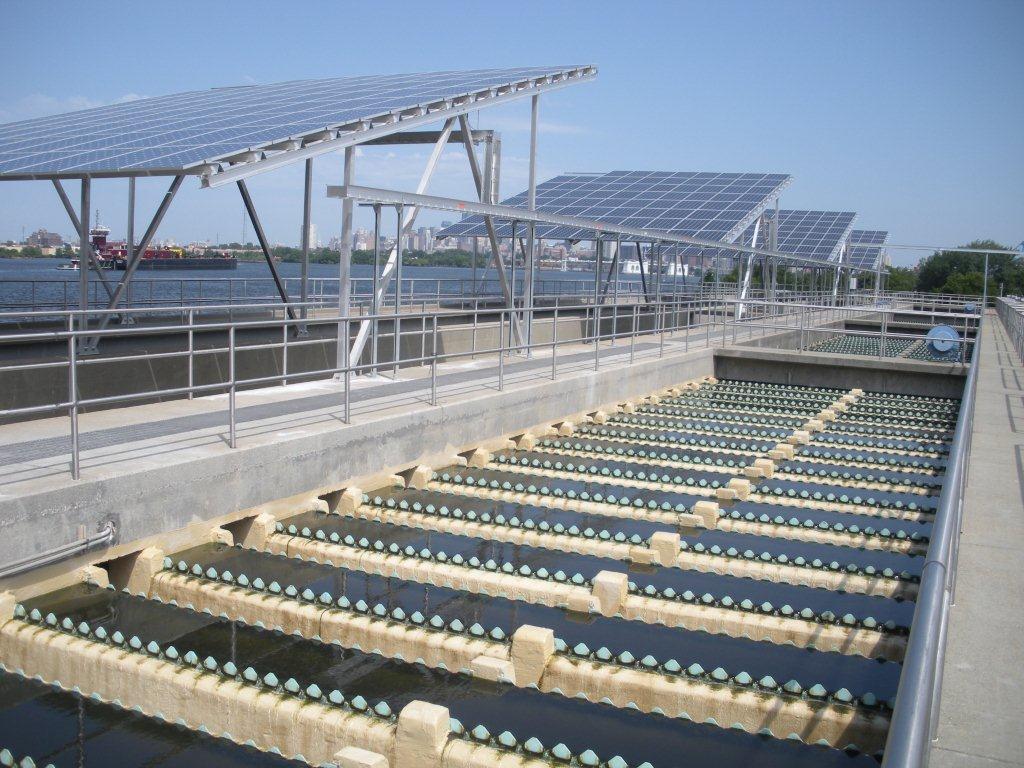
Maintaining balance, understanding service conditions, and reviewing available technologies are essential when navigating the crowded marketplace of coatings and linings for the corrosion protection of wastewater infrastructure.
The wastewater environment is uniquely destructive. Manholes, pipelines, lift stations, and treatment plant structures are constantly exposed to corrosive substances, biological activity, and moisture cycles. These conditions that can quickly degrade concrete and steel. Protective coatings and linings have therefore become one of the most important tools for extending the life of municipal wastewater assets.
According to an independent survey of wastewater engineers, municipal managers, and contractors, a protective lining’s permeability to corrosive agents is one, if not, the single most important factor during product selection. But choosing the right system requires more than comparing one or two properties. It requires an understanding of the history, environment, and performance expectations that shape today’s asset-management decisions on protective coating and lining system applications.
A Brief History: The Roots of Municipal Asset Management
For much of our nation’s history, municipal wastewater infrastructure has received relatively little attention compared to other public works. As communities grew, investment focused on roads, bridges, power, natural gas, and drinking water. By contrast, sewer systems were often built quickly, primarily using concrete and put into service without much thought to long-term durability.
Over time, this infrastructure inevitably aged and deteriorated. Over the last several decades, increasing environmental regulations, public health considerations, and infrastructure funding challenges have pushed municipalities to rethink asset management. The result: a stronger focus on corrosion prevention, rehabilitation, and lifecycle extension.
The Rise of Protective Linings and the Coatings
As corrosion became more visible and costly, interest in protective linings surged. Early solutions came from companies, like Sauereisen, already serving heavy industrial markets, such as chemical processing, power plant flue-gas systems, food and beverage and various types of primary and secondary containment of aggressive chemicals. If a coating or lining could handle acidic industrial environments, the thinking went, it should be suitable for municipal wastewater.
Some industrial coatings were cross marketed with little modification. Others, such as the Sauereisen SewerGard systems, were specifically formulated for sewer gases, wastewater immersion and MIC (Microbiologically Induced Corrosion) attack. As more products entered the market, suppliers sought ways to stand out:
- Some emphasized physical strengths, particularly compressive strength
- Others emphasized chemical and abrasion resistance or permeability
- Some leaned on ease of application or fast cure times
While all of these characteristics have value, the growing number of claims often led to confusion. Specifiers sometimes concluded that if Vendor A exceeded Vendor B on a particular property, Vendor A must be superior. But this logic only holds when that property is genuinely critical to performance. If the “super-strength” characteristic, such as high compressive strength, provides no practical benefit in an underground or treatment environment, specifiers may inadvertently eliminate a more cost-effective, equally suitable product.
Rethinking What Matters: Key Considerations for Lining Selection
With so many competing claims, which factors truly matter?
1. Chemical Resistance and Permeability (Most Important)
In wastewater systems, all of which are eventually affected by MIC, chemical resistance and permeability are paramount. Chemical resistance, water vapor transmission, permeance, and permeability determine whether corrosive gases and acids reach the substrate through a properly applied coating or lining system.
If overall chemistry isn’t adequately addressed, other properties become irrelevant.
2. Application Environment
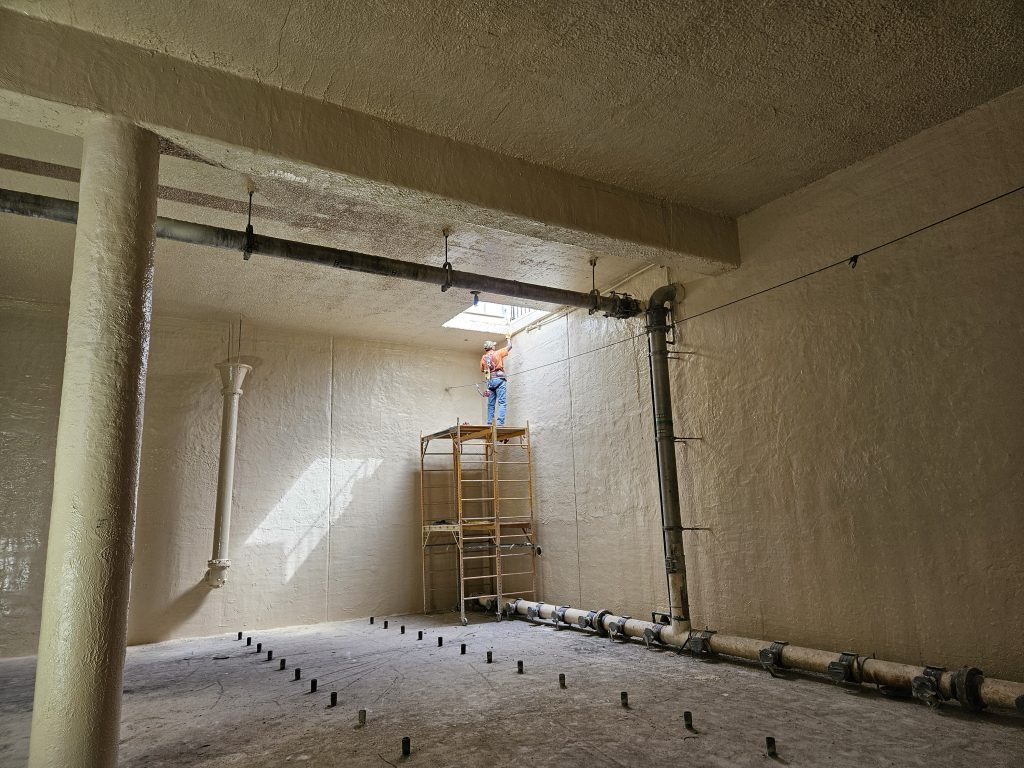
Linings are typically applied by various spray methods or by hand application. A product that is theoretically strong but difficult to apply consistently in a confined space may underperform in practice. Ease of application is important in terms of performance and cost effectiveness.
3. Overvaluing Physical Strength
Physical strength is often overemphasized. While linings must withstand dynamic forces, a physical strength that far exceeds host substrates in wastewater structures does not necessarily add any real value. A typical 1/8-inch (125 mil) lining system does not add any real structural value to a concrete structure that is many times thicker than the lining system A coating’s strength is only as useful as the strength of the concrete behind it.
4. Understanding the Trade-Offs
Extreme properties usually come at the expense of others. High-build systems, ultra-fast cures, and exceptionally rigid materials may introduce brittleness, reduced adhesion, or lower chemical resistance.
Balancing properties is more valuable than maximizing any single one.
The Most Overlooked Factor: Real-World History
Beyond lab tests and marketing data, one criterion rises above all others:
Past performance in similar conditions.
A documented history of success in real wastewater environments is the strongest indicator of long-term durability. No simulation can fully replicate the complex chemistry of active sewer systems subjected to microbial communities, fluctuating pH levels, temperature changes, turbulence resulting in abrasion, and variable gas loads in vapor zones.
In other words, field results matter. Proven systems, such as the Sauereisen SewerGard coating and lining systems, with many decades of in-service history, combined with adherence to strict ASTM testing methods, provide a level of confidence that testing alone cannot.
Conclusion: Balancing Science, Performance, and Practicality
No single technology or manufacturer will dominate the protective coatings and linings market, and that’s good news for specifiers. It means there are multiple reputable choices, each with strengths suited to particular environments and conditions.
When selecting a protective coating or lining for wastewater collection or treatment applications:
- Keep the entire service environment in view
- Understand the overall chemistry, including MIC risks, abrasion, etc.
- Balance physical properties rather than overvaluing one metric
- Evaluate permeability and chemical resistance first
- And above all, consider real-world performance history
In wastewater environments, where corrosion is aggressive and continuous, the right lining is essential to preserving infrastructure. By grounding selection decisions in a combination of science, experience, and practicality, municipalities can extend the life of critical assets and ensure reliable, long-term service.
Sauereisen offers Engineered Solutions for Municipal Wastewater.
Protect your valuable infrastructure with the engineered systems that last. At Sauereisen, we draw upon over 126 years of industry experience to produce high-quality corrosion resistant products for municipal wastewater. Contact us at www.sauereisen.com or call Sauereisen at +1 (412) 963.0303 today — the first step toward long-term protection. We’ll help you find the right solution.