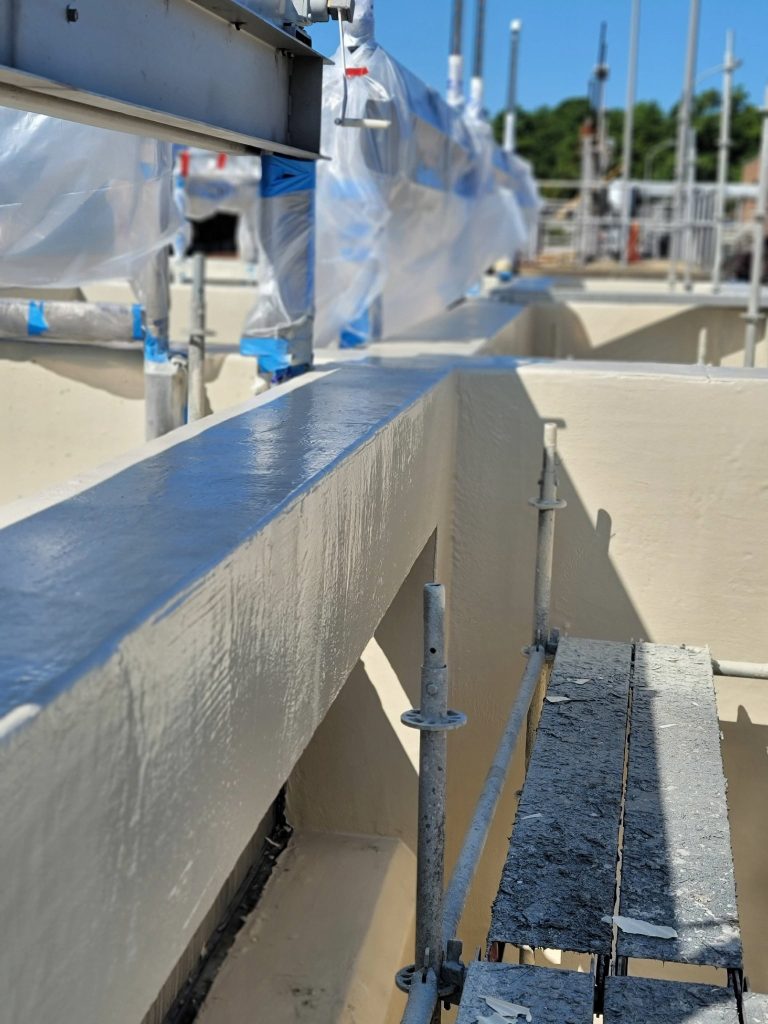
Selecting a protective lining for wastewater infrastructure isn’t just about choosing the strongest material on paper. More importantly, it’s about choosing the right performance characteristics for the environment. In wastewater applications, long-term protection depends far more on chemical resistance, permeability, adhesion, and abrasion resistance than on traditional mechanical strength metrics.
The Challenge Beneath the Surface
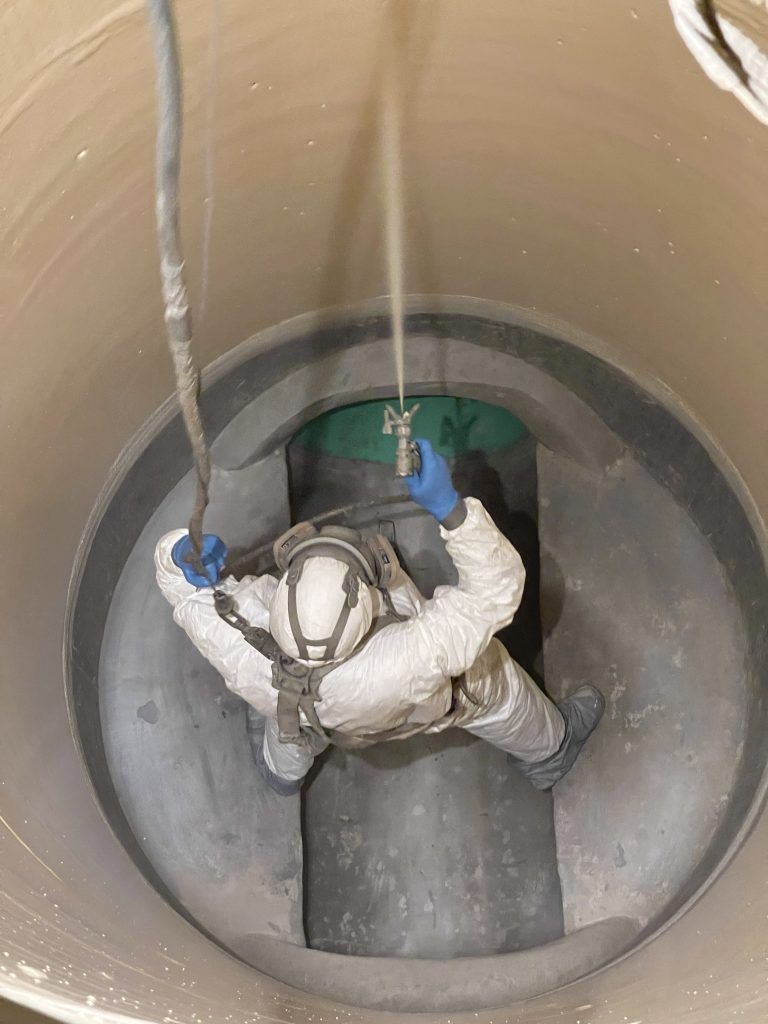
Wastewater environments are among the most aggressive service conditions for concrete and steel. Infrastructure such as manholes, pipelines, lift stations, and treatment facilities facility structures are exposed to hydrogen sulfide gas, microbiologically induced corrosion, moisture, and continuous flow conditions.
Protective linings serve as the primary barrier between these harsh conditions and the underlying substrate. Their effectiveness is determined not by how strong they are in isolation, but by how well they extend service life by preventing degradation over time.
What Matters Most: Barrier Performance and Durability
An independent survey of wastewater professionals revealed a critical insight: resistance to chemical permeation is the most important, and most commonly overlooked factor in protective lining selection.
This reinforces a broader truth. The most critical performance properties in wastewater linings are:
- Chemical resistance – the ability to withstand acids, sulfides, and other corrosive agents that are common to wastewater environments
- Low permeability – preventing the ingress of moisture and chemicals through the lining and into the substrate
- Adhesion – maintaining a continuous, monolithic bond to the substrate to stop attack on the substrate
- Abrasion resistance – withstanding wear from flow, grit, and debris
If a lining fails in any of these areas, deterioration will occur, regardless of how impressive its physical strength properties may appear on a data sheet.
The Misplaced Emphasis on Physical Strength Properties
In contrast, properties such as the compressive, tensile and flexural strengths of a product are often overemphasized in specifications.
While these metrics are easy to quantify and compare, their relevance in wastewater environments is frequently limited, and are not always the most critical factors in choosing a protective lining. For example:
- Compressive strength is far more critical for structural materials than for thin-film linings applied to vertical or overhead surfaces
- Tensile and flexural properties may have value in crack-bridging scenarios, but do little to prevent chemical attack if permeability is high
- A lining with exceptional strength can still fail quickly if it allows chemical ingress or loses adhesion
- Concrete is the most common substrate in wastewater, and most protective linings provide physical properties two, three or four times the physical strengths of the concrete, far in excess of what is needed, so in reality, the highest strength product is not necessarily superior
In most cases, pushing for extreme mechanical properties provides minimal real-world benefit, and may even introduce unwanted tradeoffs, such as reduced flexibility, more difficult application or greater expense.
Adhesion: The Often-Underestimated Factor
Even the most chemically resistant material will fail if it does not remain properly bonded to the substrate.
Strong adhesion ensures:
- A continuous barrier against corrosive elements
- Resistance to delamination from moisture vapor or gas pressure
- Long-term system integrity under varying environmental conditions
Loss of adhesion is one of the most common, and most costly failure modes in wastewater linings. Adhesion is not determined solely by physical strength, and factors such as proper surface preparation are as least important as strengths.
Abrasion Resistance in Flow Conditions
In systems with active flow, such as channels, pipelines, wet wells, and influent structures, abrasion resistance becomes equally critical.
Grit, sand, and debris can gradually erode the lining surface, reduce the thickness of the protective barrier and accelerate failure. A lining that performs well chemically but wears away mechanically will not deliver long-term protection.
Proven Performance Still Matters
Beyond individual properties, real-world, case history performance remains one of the strongest indicators of success. Linings that have demonstrated long term durability in similar wastewater environments provide confidence that lab data alone cannot.
Successful field history validates the balance between physical strengths, chemical resistance, permeability, adhesion, abrasion resistance, and overall performance.
Striking the Right Balance

The goal in specifying a protective lining is not to maximize every property, but to prioritize the ones that directly impact performance in service.
In wastewater environments, that means:
- Prioritizing chemical resistance and low permeability
- Ensuring strong, durable adhesion
- Accounting for abrasion in flow conditions
- Avoiding overemphasis on non-critical, high strength properties
By focusing on how a lining performs in the real environment, rather than how it performs in controlled lab tests, engineers and asset owners can make more informed, cost-effective decisions.
Final Thought
A lining typically does not fail because it lacks compressive strength. It fails because corrosive agents penetrated it, wore it away, or caused it to lose bond.
Keep focus on what truly protects the structure: chemical resistance, permeability, adhesion, and validated durability in service.